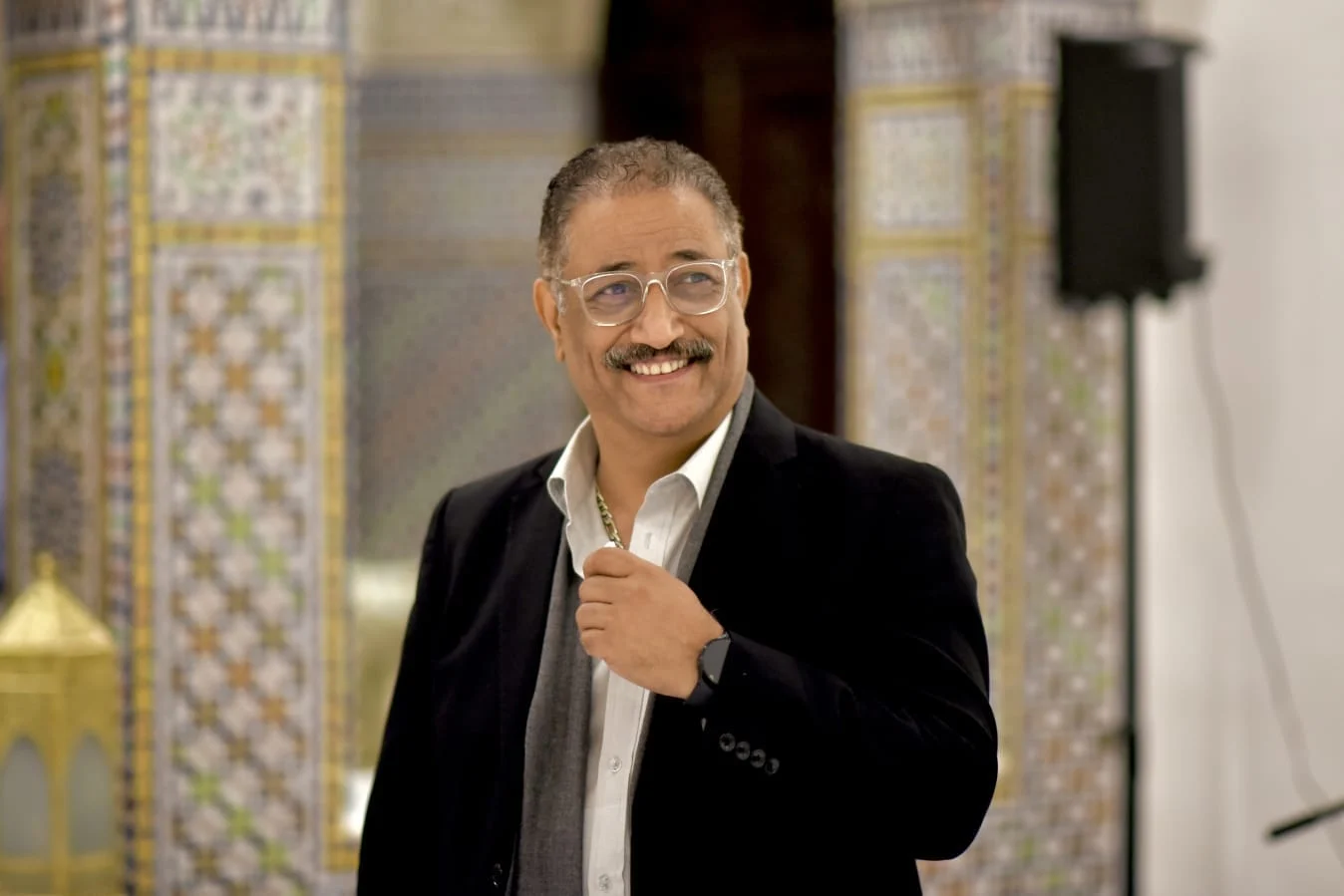
Bassam Mohammed Al Thawadi
Film director
Bassam Mohammed Al Thawadi is one of Bahrain’s leading film directors. He earned a bachelor’s degree in directing at Cairo’s Higher Institute of Cinema in 1983. His further training included a course on international media for department heads and managers in Bahrain in 1996 and a course for television production managers in Damascus in 1997.
He headed drama and documentaries at Bahrain’s Radio and Television Authority from 1997 to 2004. He had previously chaired the Authority’s television drama script committee from 1993 to 1998. He also held many seminars and gave lectures on cinema and television in Bahrain and the Gulf states.
His filmmaking earned him certificates of recognition from Arab and international festivals, including the Cairo, Carthage and Damascus film festivals and the Middle East festival in Tokyo.
From 1989 onward, he devised academic training programmes for announcers, presenters and directors. He served on the board of the Radio and Television Authority’s training centre from 1998 to 2001 and taught television part-time in the Media Department at the University of Bahrain’s College of Arts.
Al Thawadi has worked in many areas of cinema. His paper « The State of Cinema in the Arab Gulf Countries », presented at a seminar on Arab cinema in Kuwait in 1995, documented Gulf filmmaking. In October 1993, he founded the New Egyptian Cinema Days and oversaw its production and general coordination in partnership with the Ministry of Information and the Bahrain Cinema Club. He was also entrusted with supervising and directing the fifth Arab Song Festival, held in Bahrain in November 1996.
The following sections document his work with committees and associations, his festival jury service, his directing for film, television and theatre, and his attendance at major conferences and meetings in Arab countries and abroad. They include brief descriptions of the films he made.
1. Committees and institutions- Juror at the Baghdad International Television and Cinema Festival (1988).
- Juror at the Abu Dhabi Cultural Foundation’s Video Film Festival (1991).
- Jury chair at Bahrain’s Al Sawari Theatre Video Festival (1994).
- Juror at the fourth Cairo International Radio and Television Festival (1998).
- Juror at the sixth Gulf Television Production Festival (March 1999).
- Juror for State Encouragement Award in arts, literature, and the social sciences and humanities (2001, 2002, 2003, 2004).
- Documentary juror at the Arab Cinema Festival, Paris (2002).
- Jury chair for the Toastmasters clubs’ theatre competition at the Gulf Air Club, Bahrain (24 June 2005).
- Founding member of the Gulf Cooperation Council’s founding committee for cinema.
- Secretary-general of the Cinema Association of the Gulf Cooperation Council countries.
- Member of the Bahrain Cinema Club since 1985.
- Founder and director-general of the Arab Cinema Festival in Bahrain, March 2000.
2. Film work: directing
- A series of 8 mm short films made between 1974 and 1978 and screened at a seminar at the Graduates Club in 1981.
- « Al Qinaa » (The Mask), a 16 mm drama short about the Camp David Accords (1981).
- « Malaikat Al Ard » (Angels of the Earth), a 16 mm drama short about the Sabra and Shatila massacres (1983).
- The Barrier (1990), a feature written by Amin Saleh and Ali Al Sharqawi, is considered Bahrain’s first narrative feature. Al Thawadi produced and directed it, and it screened at numerous Arab and international festivals. Its opening screening took place at Awal Cinema on 6 June 1990. In attendance were Jawad Al Arrayed, then Minister of Health; Dr Ali Fakhro, then Minister of Education; and Dr Hala Al Omran, Assistant Undersecretary for Radio and Television Affairs.
- Visitor (2003), a feature written by Bassam Al Thawadi and Fareed Ramadan, is considered the second Bahraini feature and the first Gulf film to use Dolby sound. Produced by the Bahrain Cinema Company and Al Thawadi, it screened at numerous Arab and international festivals. The opening screening was at Cinema 14 in Seef Mall on 5 April 2004. Those present included Information Minister Nabeel Yacoub Al Hamer; Mohammed Ibrahim Al Mutawa, adviser to the Prime Minister on cultural affairs; Health Minister Khalil Hassan; Labour Minister Dr Majeed Al Alawi; Commerce Minister Ali Saleh Al Saleh; Dr Essam Fakhro, managing director of the Bahrain Cinema Company; and members of the Shura Council and the Council of Representatives.
3. Television work: directing and development
- Variety programmes: F 8 (1985), Alwan (1985), Zoom (1985), Al Nas Wal Eid (1985), Clapperboard (1986), Video Cinema (1986–1988), Farhat Al Eid (1986), Al Sahra Al Maftouha (cinema, theatre and song; six instalments, 1987–1988), and Take Two. 1987 ) – Bath Ghair Mubasher, developed by Amin Saleh and Qassim Haddad (1991); Television Suwar Al Mulawwan, developed by Amin Saleh and Muneera Hassan (1994); and a selection of Arabic songs.
- Joint Arab evening programmes: Nagham, Ra’y, Liqaa and Hay’a 94.
- A number of commercials and educational and cultural programmes.
Documentaries and tourism films: Bahrain, a Bright Face (1986); A Homeland and a Citizen (1987); Intellectual and Cultural Ties Between Bahrain and Saudi Arabia (1986); The Citizen: Tree of Life (1987); New Dawn (1986); Arad Fort (1988); Bahrain Training Institute (1996); Nada Water (1997); Precious Pearls (1997); Authentic Pearls (1998); Bahrain, Island of the Radiant Smile (1998); Flower of Love (1999); and Endurance Race Promo (December 2001).
Television drama
- Al Ain trilogy (1988), written by Rashid Al Jowder; Younis and the Others (1989), a television drama based on a work by American author John Keefauver and adapted by Amin Saleh; Eyes Beneath the Skull (1990), a television drama written by Hamad Al Shehabi; Another Girl (1992), a series written by Hamad Al Shehabi; Hassan and Nour Al Sana (1994), a series written by Hamad Al Shehabi, which won awards for lighting and best supporting actress at the 1995 Cairo Television Festival; The Fugitive (1995), a series written by Amin Saleh and Qassim Haddad; and Arab Poets (1985, acting role).
IV. Stage work
- The Author, written by Ali Salem, won first prize at the inaugural theatre festival in Kuwait in 1985 (acting role).
- Yood Aleih, a play by Hassan Aoun (1985, acting role).
- Othello Returns by Nikos Kazantzakis (1981, acting)
- Echo of Longing, operetta (1991, director).
- Farah and Marah Festival for the Dallah Al Baraka Group in Saudi Arabia (1988, director).
- A Tribute to Bu Salman Festival (2001, direction and general supervision).
- Long Live Hamad, operetta (February 2002, direction and general supervision).
- He held a photography exhibition in Cairo in 1980.
1. Meeting of Gulf television directors for the Joint Programme Production Institution (Kuwait, 1996).
2. Meeting of satellite channels belonging to the Arab States Broadcasting Union (London, 1996).
3. Emergency coordination meeting of Arab States Broadcasting Union satellite channels (Beirut, May 1999, and Cairo, June 1999).
4. Attended the meeting of Gulf Cooperation Council information ministers in Riyadh in 1997.
VI. Films completed
Film title: Loyalty
Year of production: 1975
Genre: Action drama
Format: 8 mm, silent
Story, acting, cinematography and direction: Bassam Al Thawadi
Editing: Abdullah Al Ansari (Al Saqr) and Bassam Al Thawadi
Cast: A group of Thai performers
Running time: 12 minutes
Synopsis
A young Thai man sells drugs to a group of fellow Thais who double-cross him once he delivers the shipment. He tells his Bahraini friend that he intends to take revenge. His friend urges him to walk away, but he insists on going back to the gang’s hideout. His friend follows him without his knowledge. When the gang captures the young man, his friend rushes to help and is killed. After overcoming the gang, the young man buries his Bahraini friend at its hideout.
Film title: The Blind Man
Year of production: 1976
Genre: Action drama
Format: 8 mm, with sound
Story, acting, editing and direction: Bassam Al Thawadi
Cinematography: Samir Al Saati
Cast: Bahraini performers from the Al Makharqa troupe, with karate instructor Al Aradi
Running time: 20 minutes
Synopsis
Ahmed loses his sight in a car accident and learns self-defence at the Bahrain Karate School in Muharraq. He discovers that a close friend has been involved in crime when the friend robs the school director’s home. Their confrontation ends with Ahmed prevailing.
Film title: The Two Brothers
Year of production: 1977
Genre: Action drama
Format: 8 mm, with sound
Cinematography: Samir Al Saati
Cast: Bahraini performers from the Al Makharqa troupe
Running time: 15 minutes
Synopsis
Ahmed is involved with a gang of young burglars. One night, he falls as they flee, and no one comes back to rescue him. After being released from a correctional institution, he finds a job and starts turning his life around. The gang leader asks him to help rob the company safe, since Ahmed alone knows where the safes are. When Ahmed refuses to go back to stealing, the gang kidnaps his younger brother to force him to take part. Ahmed manages to rescue his brother and expose the gang.
Film title: Generations
Year of production: 1977
Genre: Tradition and modern life
Format: 8 mm, with sound
Story, editing and direction: Bassam Al Thawadi
Cinematography: Samir Al Saati and Bassam Al Thawadi
Cast: Yusuf Hammoud, Ahmed Jassim, Khalil Ali, Bassam Al Thawadi and Mohammed Al Shawish
Running time: 20 minutes
Synopsis:
In 1954, facing financial hardship, Hajj Hassan takes his friends’ advice and goes to work in Saudi Arabia. He builds a modest fortune but dies before returning to his wife and son in Bahrain. When his son grows up, he squanders his father’s money in bars and nightclubs. The film ends with the son’s death after a fight in a bar.
Film title: The Mask
Year of production: 1981
Genre: Political
Format: 16 mm, silent
Screenplay and direction: Bassam Al Thawadi
Cinematography: Mustafa Ezz El Din
Editing: Nagwa Al Mallakh
Supervisor: Film director Mohammed Bassiouni
Cast: A group of young performers
Running time: Two and a half minutes
Synopsis:
The film uses symbolism to explore the Camp David Accords and their impact on the Arab world.
Film title: Angels of the Earth
Year of production: 1983
Genre: Fantasy
Format: 16 mm, with sound
Screenplay and direction: Bassam Al Thawadi
Cinematography: Mustafa Ezz El Din
Set design: Layla Al Sherbini
Editing: Nagwa Al Mallakh
Music: Saeed Al Souri
Cast: Abdullah Mahmoud and Mamdouh Saleh
Running time: 22 minutes
Synopsis:
B.M., a writer, and M.A., a musician, dream of returning to Beirut to fight against Israel, but they cannot get visas. B.M. writes lyrics about going to Beirut to help defend the Arab homeland. M.A. likes the words and sets them to music. At the end they sing the song, and we discover that their voices come from a cemetery: both died in the Sabra and Shatila massacres, and the film had been taking place beneath the cemetery all along.
The Barrier
The first Bahraini narrative feature film
Produced and directed by Bassam Al Thawadi
Screenplay: Amin Saleh
Dialogue: Amin Saleh and Ali Al Sharqawi
Cast: Rashid Al Hassan, Ibrahim Bahr, Qahtan Al Qahtani, Maryam Zaiman, Abdulrahman Barakat, Latifa Mujran, Souad Ali and Tufool Qassim Haddad.
Director of photography: Hassan Abdulkarim
Editing: Youssef Al Mallakh
Music: Hany Shenouda
Produced in 1990 · 127 minutes · 35 mm
Film synopsis
The film examines the social and psychological barriers between individuals and society, and between individuals and their own selves. The characters struggle to communicate, to understand one another and even to understand themselves. They cannot form healthy relationships, above all because they lack love and because they live in an environment that gives relationships little chance to grow and develop.
Hassan, the main character, puts a barrier between himself and others and between himself and his own inner life. The barrier takes the form of his video camera. Through it he sees the world as he imagines it, not as it really is. He shuts himself inside a world of his own making and pays little attention to other people’s problems or crises. He cannot connect with his family or understand his friend’s feelings and difficulties, and his negative attitude costs him the woman he loves.
Visitor
Co-produced and directed by Bassam Al Thawadi
Produced by Bahrain Cinema Company
Story: Bassam Al Thawadi
Screenplay: Fareed Ramadan
Cast: Fatima Abdulrahim, Ahmed Mubarak, Ali Al Ghurair, Ahmed Aqlan, Amin Al Sayegh, Mustafa Rashid and Jamaan Al Rowaie.
Cinematography: Ahmed Al Thawadi
Editing: Rashid Obeid
Lighting: Abdullah Jameel
Sound: Younis Al Kooheji and Karim Mahfouz
Music: Nawaf Kamal
Assistant director: Khalid Janahi
Produced in 2003 · 87 minutes · 35 mm
A mysterious figure has appeared to Fatima since childhood. The visions haunt her, cause her intense distress and lead her to search for an explanation. She discovers a hidden link between the A’ali burial mounds and the figure that appears to her everywhere. Her ex-husband Ali and a colleague at the television station begin to help her through a crisis that is taking over her life. The story unfolds around the ancient burial mounds of A’ali, where Fatima eventually learns who the figure is and uncovers her own hidden secret.