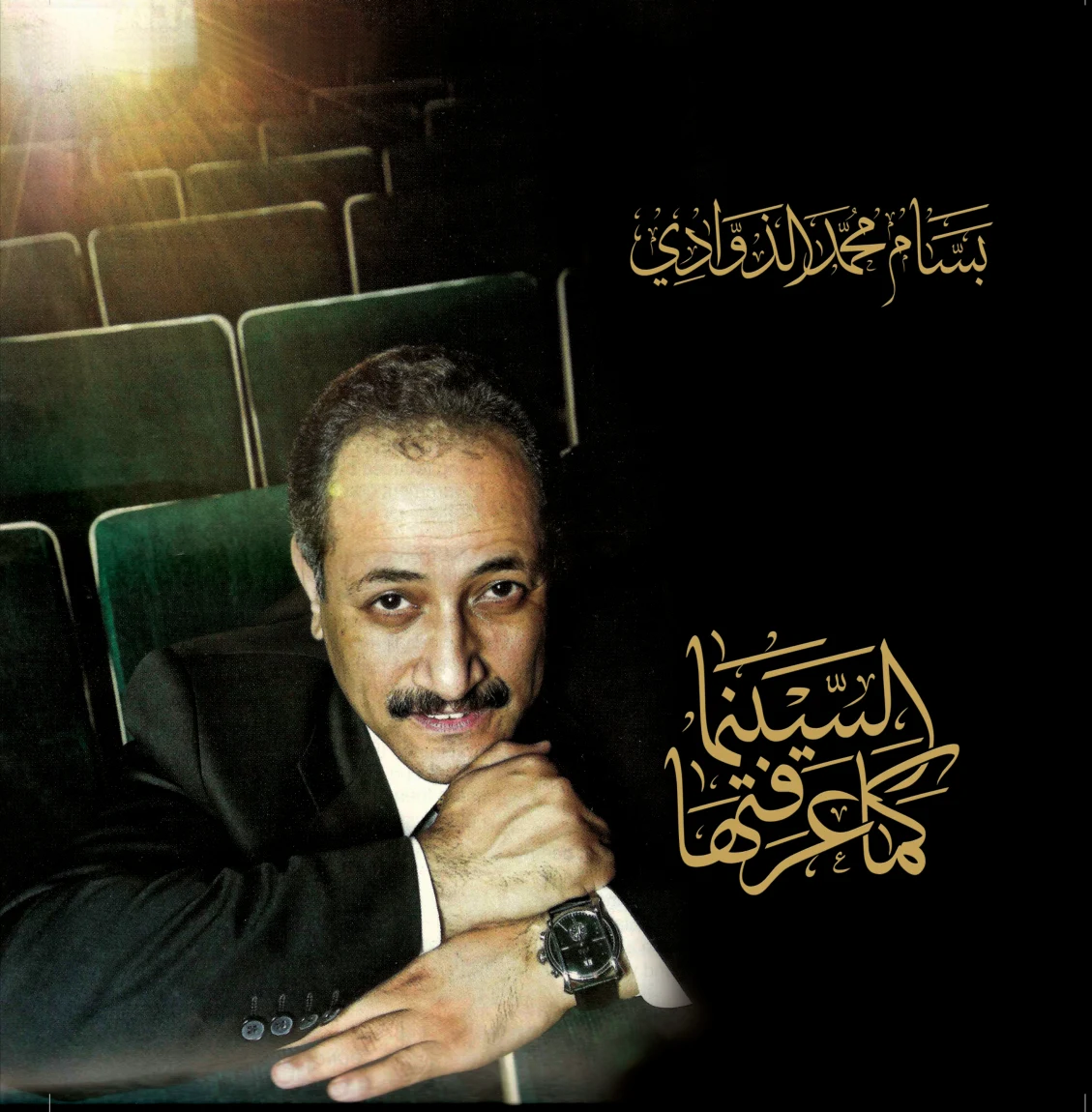
Browse the scanned first edition as it originally appeared. Most scans show two facing pages.
Browse the book
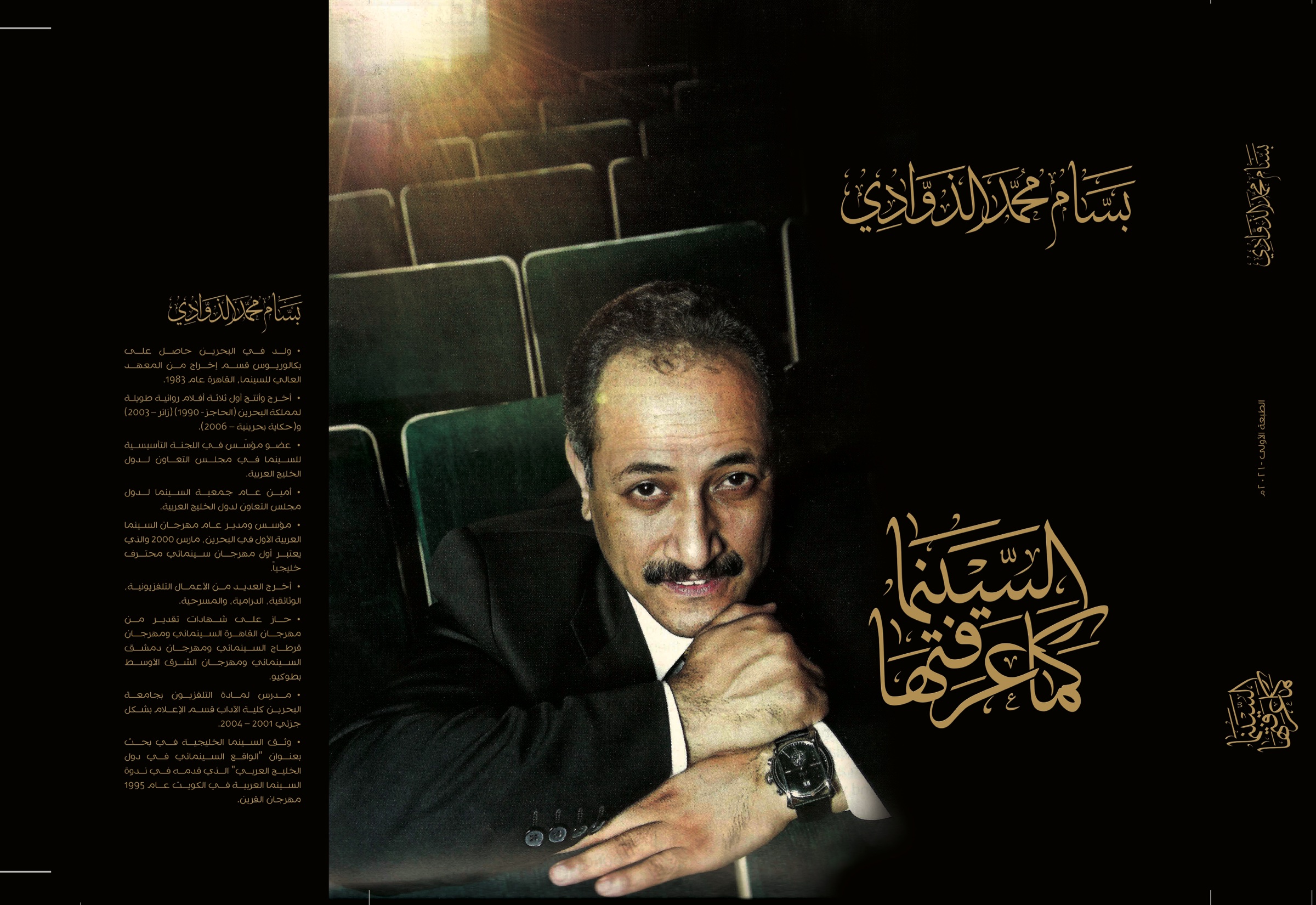
Download the scanned book (PDF, Arabic) (opens in a new tab)
Essay: Cinema as I Knew It, and as It Knew Me
By filmmaker Bassam Al Thawadi, .
From the original archive, with personal details removed.
Download the 2023 version (PDF, Arabic)
Part I: Cinema as I Came to Know It
I was born in Bahrain.
My father had managed the showroom of the Abdullah Ali Al Khaja establishment in Al Khobar, Saudi Arabia, since 1954, so I lived and went to school in Saudi Arabia until 1969. That is where my love of images began, with the comics my late father started giving me in 1964. Among them was Superman, whose first Arabic issue came out on 6 February 1964; the first American issue appeared in June 1938.
My father loved photography, and he was also the one who first taught me how to take pictures.
Before we went back to Bahrain, my mother took me to the Al Gosaibi home in Saudi Arabia. Only women were there, and to my surprise they screened the Egyptian film Shabab Magnoun Geddan (Very Crazy Youth), made in 1967. The screen seemed enormous to me, and I was spellbound. I wanted one of those 16 mm projectors. By 1976, I had amassed a large collection of comics, which I sold for six dinars to Ahmed Al Mahoozi, then manager of Al Mahoozi Bookshop. I put that money towards an 8 mm projector and two cartoons, which I bought for six and a half dinars at a toy shop near my father’s Ocean Store on Bab Al Bahrain Street.
I bought my first Super 8 camera in 1975, while working a summer job as a messenger in the public relations department of the Ministry of Interior.
I directed several short films. I shot my first, Al Wafa (Loyalty), in 1975 with staff from the Pearl Restaurant, which was in the Jashanmal building in Manama, across from the old courthouse.
I acted in, shot and edited the film with help from Khalifa Shaheen, director of Al Saqr Photography, whose professional staff helped me with the editing. At the time, I did not even know what editing meant, let alone the vocabulary of cinema. I learned it from him.
I happened to see films by Ali Abbas, Majid Shams, Darab Nayrouz and Abdullah Al Hamad. I can no longer remember where: was it Al Orouba Club or Al Nusoor?
That gave me the courage to make The Two Brothers, The Blind Man and Generations.
I was delighted when the 14 September 1976 issue of Sada Al Osbou announced what was to be the first Bahraini film, Al Ahdab (The Hunchback), directed by Ibrahim Janahi. Sadly, it was never completed after the death of the director’s brother, my schoolteacher Abdulaziz Janahi. The footage they shot remains in its cans to this day.
After secondary school I worked at Mohammed Al Mannai’s Universal Cold Stores in Gudaibiya to save for a ticket to Cairo and sit the entrance exam. Ahmed Al Zayani, on behalf of the Ministry of Information, told me I had to be admitted to the film institute before I could receive its scholarship. I went to Cairo, was accepted and studied film until 1983. I made two films there: The Mask, about the Camp David Accords, and Angels of the Earth, about the Sabra and Shatila massacres.
I began working in broadcasting in 1985, two years after graduating. I joined Bahrain Television at the Ministry of Information and remained at the ministry until 2015.
While in Cairo, I directed the students’ annual celebrations and coached them in expressive movement. I also directed most of the Isa Town Club’s annual celebrations.
In 1981, I acted in Nikos Kazantzakis’s Othello Returns, directed by Abdullah Malek. In 1985 I played something close to a lead role in two more productions directed by him: Ali Salem’s The Author and Hassan Aoun’s Yood Aleih. I acted in most of the films I directed at the time and in some television dramas of the 1980s, including Arab Poets.
In the early 1970s I learned to draw with Ahmed Nashaba. In 1975 I began making my own drawings so I could depict the stories I imagined or saw on television. I kept drawing until 1995. It drew me into the world of the visual arts and introduced me to Rembrandt, Picasso, Salvador Dalí and Van Gogh.
Throughout the 1970s I admired Bahraini poets such as Ibrahim Al Arrayed, Al Muawda, Qassim Haddad, Ali Al Sharqawi, Ali Abdullah Khalifa and Abdulrahman Rafi. Inspired by them, I began writing reflections in 1979. Qassim Haddad had the strongest influence on me. Without quite realising it, I discovered how he put the image in a word, then placed it beside another word so that the two made meaning, much as I joined images. In 1982 I completed my book Al Raneen (Resonance). The year before, with help from fellow students in Cairo, I held my first photography exhibition.
While studying at the institute I acted in graduation projects by other students, including a film by the Omani director Khamis Musafir, Lost Image by the Omani director Mansour Abdulrasool, and The Arabs by the Jordanian director Nasser Najib. After seeing the films, Amin Saleh told me, “Please, I beg you, don’t act. You don’t look the part.” I laughed and kept acting. I did not act to become an actor, draw to become an artist, write poetry to become a writer, practise expressive dance to become a dancer, or study music to become a musician. I tried all of it to become a film director.
I only realised this in the early 1980s. In Cairo, reading Magdi Wahba’s Dictionary of Film Art, I discovered that cinema is called the seventh art, after music, architecture, sculpture, dance, poetry and painting. I thought that to understand cinema I had to know and try the other six. I read free verse by May Ziadeh, Nizar, Qassim Haddad and Ali Al Sharqawi, as well as short stories by Amin Saleh, Mohammed Abdulmalik and others. My father’s shop on Bab Al Bahrain Street was close to Al Mahoozi Bookshop and the National Bookshop. I read stories by Farouk or Ibrahim Obeid and listened to Dr Alawi Al Hashemi and Ali Al Arrayed talk about culture and the latest books when they gathered at my father’s shop.
That led me to buy the first book I ever paid for myself: Charles Darwin’s On the Origin of Species, from Al Mahoozi Bookshop.
I listened to and analysed Mozart, Beethoven and Bach. I also delighted in the political songs of Sheikh Imam, Ahmad Kaabour and others, analysing them with what I had learned in music and score reading as part of my directing and production studies.
I wrote lyrics for opening performances by the students in Cairo and in Isa Town. I adapted Pablo Neruda’s poetry to a Bahraini setting and set it to music for the operetta Ihna Al Masakeen (We, the Poor) -99-. I also wrote short screenplays for some students.
I began learning expressive dance and teaching it to the students, then brought it into plays for children and adults.
To try my hand at architecture, I designed sets and signs.
I did all this to understand cinema and the tools I would have at my disposal as a filmmaker. I thought I had learned everything until I met Qassim Haddad and gave him the poetry book I had written. He said I had the beginnings of a poet in me but much still to learn. I told him I was no poet; I was only trying to understand words and meanings. He suggested Homer’s Iliad and Odyssey. Suddenly the sea seemed much larger. I immersed myself in that epic world and learned a great deal about life and literature. I went on to read the ancient Greek plays of Sophocles and Aeschylus, the works of Naguib Mahfouz, Youssef El Sebai, Yusuf Idris and Farag Foda, and the poetry of Ahmed Fouad Negm and Farouk Gouida.
I turned to film criticism and read Samir Farid and Sami Al Salamouni, but even that was not enough. The actor Mahmoud Morsi, who taught me directing, and the psychologist Dr Hussein Abdelkader urged me to read Sigmund Freud to understand characters. I began with books by Dr Mustafa Ziywar and by Freud. I loved the way Freud put words together, described and analysed mental states, and developed free association for his patients. I applied that technique to the fictional people I imagined while writing characters for the screenplays assigned at the film institute. I questioned and analysed them.
By then I knew that understanding cinema and what it is was not easy. The films I watched by Fellini, Antonioni, Pasolini, Roberto Rossellini, De Sica, Visconti, Buñuel, Tarkovsky, Billy Wilder, Frankenheimer, David Lean, Kurosawa and Bergman were no longer as easy to watch as the first time. Even a little knowledge and culture made them more challenging and more beautiful. It was as though a language were exploding, as Amin Saleh put it, yielding different, greater and deeper meanings than I had found on first viewing.
When I returned from Egypt and joined Bahrain Television in 1985, I began directing programmes. I used film terminology in all of them to draw viewers’ attention to it and help them learn about cinema.
I began working in broadcasting in 1985, two years after graduating, at Bahrain Television in the Ministry of Information, and stayed at the ministry until 2015. I directed the programmes Clapperboard, F8, Video Cinema, Zoom, Colours, Education, and Indirect Broadcast, and the series Al Ain, Hassan and Nour Al Sana, Another Girl, and The Fugitive.
In 1988 Rashid Al Jowder brought me the script of the three-part Al Ain. It was a turning point, and I owe him a great deal for it. I was able to put much of what I knew about cinema into practice: reading and understanding the script, bringing a director’s vision to it, and guiding the actors and teams responsible for cinematography, production, lighting, editing, sound and music. The experience made me think about making a feature. The writer Ibrahim Bashmi had been the first to back me, bringing me Amin Saleh’s script An Evening at a Dead Man’s Head in 1985. I approached Tariq Al Moayyed and Khalil Al Thawadi, then director of television, about producing it, but I never heard back.
I lived near the Writers’ Association in Adliya and went to its talks. I grew closer to the poets Qassim Haddad and Ali Al Sharqawi and the writer Amin Saleh. We shared dreams of cinema, watched the same films and analysed them together. I learned from them how to interpret films, shots and camera movements. I felt close to them; they cared about cinema as much as I did, if not more. At one of our gatherings in my modest home near the association in 1988, Amin Saleh brought me a television script based on The Doll, a novel by the American writer John Keefauver. It was later retitled Younis and the Others and became my first television film. I was thrilled by the script and by the way Amin and Qassim explained the characters. I felt at the heart of cinema as I listened to them explain, with such simplicity, the depths of the main character played by Abdullah Malek.
It was Abdullah Malek, incidentally, who cast me in all the plays I mentioned earlier. He taught me acting and dramatic performance in a rigorous way. I owe my understanding of actors and performance to him.
From that script I made a simple television film, no more than an hour and ten minutes long. Qassim Haddad, Amin Saleh and Ali Al Sharqawi continued to support me and trust my work. In early 1989 Amin brought me the script for The Barrier. I produced it myself so as not to lose time or repeat what had happened with Ibrahim Bashmi on An Evening at a Dead Man’s Head. In April 1989, with Amin and Ali’s help, I began casting the first Bahraini narrative feature. We started rehearsing, and I chose a crew from television. Dr Hala Al Omran gave the project all the practical and moral support she could. Filming began in September and continued through December 1989. I never saw myself as the film’s producer. To me, everyone who worked on it was a producer. They stood with me at every step, without pay, to make what then seemed a distant dream for Bahrain come true.
That was the path I had to take to understand cinema, the seriousness with which it can address an issue, and its effect on society. Its depths are never exhausted, and I will keep exploring them for as long as I work in this field.
Part II: Cinema as It Came to Know Me
After finishing The Barrier and screening it for the public, I began to see more clearly what it would take to build a film industry. I became convinced that there could be no real film industry in Bahrain, or even the Gulf, without Saudi Arabia. There were several reasons.
First, an article by Amin Saleh in the May 1991 issue of Al Muntada caught my attention. Titled “Who or What Is the Cinema Audience?”, it discussed audiences’ freedom to choose their films, something Arab audiences did not have. I understood the importance of population density, which I raised in a 1992 interview. I cannot remember whether I spoke to the journalist Mohammed Fadel or the writer Fareed Ramadan. For a film industry to survive, it needs a large enough population and enough cinemas to give audiences a choice. We had only Awal Cinema, where the film screened, and the Al Hamra, Sitra, Awali, Al Nasr and Al Zubara cinemas. That was not enough. I remember calculating that a film costing $50,000, with tickets at one to one and a half dinars, needed 40,000 admissions just to break even, because the exhibitor took 50% of the revenue. The Barrier drew 13,000 Bahraini viewers, more than any of my other films, including A Bahraini Tale.
This reminds me of a conversation I had with the Iranian director Abbas Kiarostami on the same subject during the last Gulf Film Festival in Dubai. He listened and asked what I thought Ten had cost him. “Between eighty and a hundred thousand dollars?” I guessed. He laughed. “No. It cost me ten thousand dollars. The film made its money back and turned a profit. It won awards and was shown to audiences around the world. In a country like yours, always keep an eye on the budget. Don’t spend more on a film than it warrants. It can pay off even with small audiences and few cinemas. Please, always watch the budget and you’ll succeed.” I looked at him and saw his sincerity and experience in his eyes.
Second, there was the infrastructure needed to make a film. I needed experienced screenwriters, cinematographers, editors, lighting and sound professionals and, above all, producers and backers. People with those skills were hard to find in such a small population. Investors want returns, but Bahraini cinema was in its infancy. It needed time to earn the trust of local audiences before it could be distributed abroad. I nearly lost heart over this. I believe the Saudi market will offer a way through the difficulties we have faced over thirty years of trying to build Bahraini cinema.
Third, film equipment was not available in Bahrain at the time. To keep up with developments in filmmaking abroad, I had to source it from outside the country.
The best solution was to focus on film festivals and take part in as many as possible, at least across the Arab world. The Radio and Television Authority, Bahrain’s Ministry of Foreign Affairs and my friends Qassim Haddad, Amin Saleh and Ali Al Sharqawi helped make this possible. The film went to Arab and Arab-European festivals. Japan was the first country to stand behind me and support cinema in Bahrain. The Japan Foundation bought a copy, which it still holds, and invited me to Tokyo in 1992 to screen the film and discuss it with Japanese audiences. It was a rich experience for both me and Bahrain. The Arab World Institute in Paris then asked me to deposit an original print at the Cinémathèque française. I did, and its director, the filmmaker Costa-Gavras, wrote to thank me for placing my trust in the institution. European festivals began inviting the film, and the film world began to take notice of Bahrain. Since then, I have served on many juries and presented studies on Gulf cinema.
Once festivals around the world got to know me, or as I tell my wife, once cinema finally got to know me, there were studies about me, my films and my work at the University of Cambridge in Britain and at universities in Bahrain. I felt a greater responsibility. It was no longer simply about making films or earning a living. I believe cinema holds a people’s memory and culture. It is a dream for everyone, a way both to escape reality and to plunge into it. I wanted to encourage young people to enter the field and make narrative feature films for Bahrain. In 1994, Hamad Al Shehabi attempted to make the first Bahraini horror film, House of the Jinn. In 2006 he made a first children’s film, Habab and the Wizard’s Dogs. He had previously worked with me on the 1983 operetta The Palm Tree, the 1991 television film Eyes Beneath the Skull, and the series Another Girl (1992) and Hassan and Nour Al Sana (1994).
Acknowledgements
Everyone I have worked with has helped me grow, and I still learn something from each person, however modest their role may seem. I owe much of what I have accomplished first to His Majesty King Hamad bin Isa Al Khalifa for supporting me and encouraging me to continue making films; to the late Tariq Abdulrahman Al Moayyed, Minister of Information; to Khalil Ibrahim Al Thawadi, who supported me at every step; to Dr Hala Ahmed Al Omran, who stood by me on every film and stage project I brought her and helped me complete them; to His Excellency Mohammed Al Mutawa, Minister of Cabinet Affairs, who spared no effort in supporting me in Bahrain’s film initiatives, from festivals to production companies; and to His Excellency Sheikh Isa bin Rashid Al Khalifa, who insisted I continue researching and studying cinema.
Then there are those who stood by me in all my television and film work: Hassan Abdulkarim, Abdulnabi Fardan, Abdulrahman Al Mulla, Hassan Al Jaib, Yusuf Malallah and Faisal Hussein in cinematography; Mohammed Abdulkhaliq and Fathi Matar in production; Younis Al Kooheji, Hassan Fuzai, Rashid Al Muqla, Fareed Hussein and the late Abdulkarim Mahfouz in sound engineering; Mohammed Bahloul, Ayed Al Kaabi, Jamal Al Ahmed and Nabil Rashid in editing; Abdullah Jameel and the late Amer Al Amer in lighting; Salima Jamsheer, Nawal Abdulsaleh, Jamal Al Mutawa, Rashid Abdulrahman and Abdulaziz Abdulhamid in set design; Abdulaziz Mandi and Layla Murad in makeup; Rashid Al Atawi in electrics; Yusuf Al Qusair in visual effects; and the performers Abdullah Malek, Ibrahim Khalfan, Hassan Abdulraheem, Maryam Zaiman, Majida Sultan, Mohammed Awwad, Abdulrahman Barakat, Latifa Al Mujran, Zainab Al Askari, Anwar Ahmed, Ibrahim Al Ghanim, Khalifa Al Oraifi, Sami Al Qouz, Qahtan Al Qahtani, the late Humaid Murad, Yusuf Buhloul, Ali Al Ghurair, Jamaan Al Rowaie, Abdullah Waleed, Mustafa Rashid, Ahmed Mubarak, Adel Shams, the late Mohammed Al Bahdahi, Hassan Al Wawi, Hani Al Dallal, Hussein Al Rifai, Khalid Al Rowaie, Mohammed Al Saffar and Jamal Al Saqr, along with the many other artists who believed in me and stood with me.
Nor can I forget the poets Qassim Haddad, Ali Al Sharqawi and Dr Alawi Al Hashemi; the screenwriters Amin Saleh, Hamad Al Shehabi, Fareed Ramadan, Ibrahim Bashmi, Mohammed Abdulmalik, Abdulmoneim Ibrahim, the late Khalid Al Bassam and the late Abdullah Khalifa; the writer and journalist Aqeel Suwar; the late veteran journalist Ali Sayyar; the poet Ashraf Amer; the journalists Mohammed Fadel, Ahmed Abdulrahman and Osama Al Majed; the cartoonists Khalid Al Hashemi and Tariq Al Bahhar; the artist Khalid Al Shaikh; Dr Abdullah Yateem; the producers Ali Al Aradi and Osama Al Saif; Akram Miknas, Khamis Al Muqla, Hafez and Fuad Al Mutawa, Ghassan Al Shehabi, the late Mohammed Al Banki and Fawzia Rashid.
From abroad, I remember the late Mohamed Khan, Atef El Tayeb, Radwan El Kashef and Samir Farid; the critics, the late Ali Abu Shadi, Kamal Ramzi and Tarek El Shennawy; the composer Hany Shenouda; the editor Youssef Al Mallakh; the director Adel Awad; the Jordanian novelist Ibrahim Nasrallah and the Jordanian critic Adnan Madanat; the late actors Nour El Sherif and Mahmoud Abdel Aziz; the actresses Laila Eloui and Yousra; the director Inas El Degheidy; the American director Spike Lee; and the American producer Kathleen Kennedy.
And of course I thank everyone at the Ministry of Information. Over the past 35 years I was a director, then a senior director, chair of the committee for drama, scripts and documentaries, supervisor of studies and research at the Radio and Television Authority, media adviser to Al Enma Bank and, finally, acting director-general of radio and television. In 2015 I retired from government service to devote myself to film production and directing.
I owe everything I have accomplished in media, literature, television and cinema to all these people.
Thank you for being here and for listening.